You started out studying Marketing and Advertising, moved into Fashion, and ultimately found your artistic voice in ceramics. Tell us a bit about that journey.
I started studying Marketing and Advertising partly as a detour from what I knew I really wanted to do. Perhaps back then, pursuing an Arts degree wasn’t the most obvious or accessible choice; it was a bit more of a challenge. Advertising and Marketing came up as a creative alternative for someone who had focused on Economics in secondary school. That’s why I chose that course. However, I didn’t finish it because I quickly – or relatively quickly – realised it wasn’t what I wanted to do.
Despite taking that detour, do you feel that all those past lives have left a mark on the artist you are today?
Yes, absolutely. Everything we do along the way is like adding to our luggage – the suitcase we carry through life. Having spent time in Fashion and taking that Marketing and Advertising course added value and depth to what I decided to do next, which was studying ceramics. I’d say Fashion in particular – and it’s funny because I think I notice it even more nowadays – has truly become a reference point for me. The melting pot that Fashion is. The blend of different visions, the mix of multiple people’s creativity, the combination of materials, colours and patterns. I have a side to me that absolutely loves textiles, and what textiles allow us to create and invent. So, without a doubt, Fashion was an influence. I might not have been very conscious of it at the time, but it clearly was.
There is a lot of freedom in the way you express yourself, and that shines through in your work. How did you build this artistic language over the years?
Perhaps I ended up choosing ceramics because, at the time, it felt like a medium and a field that allowed me the freedom to work across different languages without being pigeonholed. To me, ceramics was a medium that let me express myself and do whatever I fancied. Whether it was a more sculptural piece or a utilitarian item for the table, it didn’t matter – one didn’t compromise the other. At least, that’s how I felt: that I could do whatever I wanted without having to fit into a specific box.
In our Portraits feature, we talk a lot about how spaces influence our creativity. Would you say this studio is the epicentre of your creative universe?
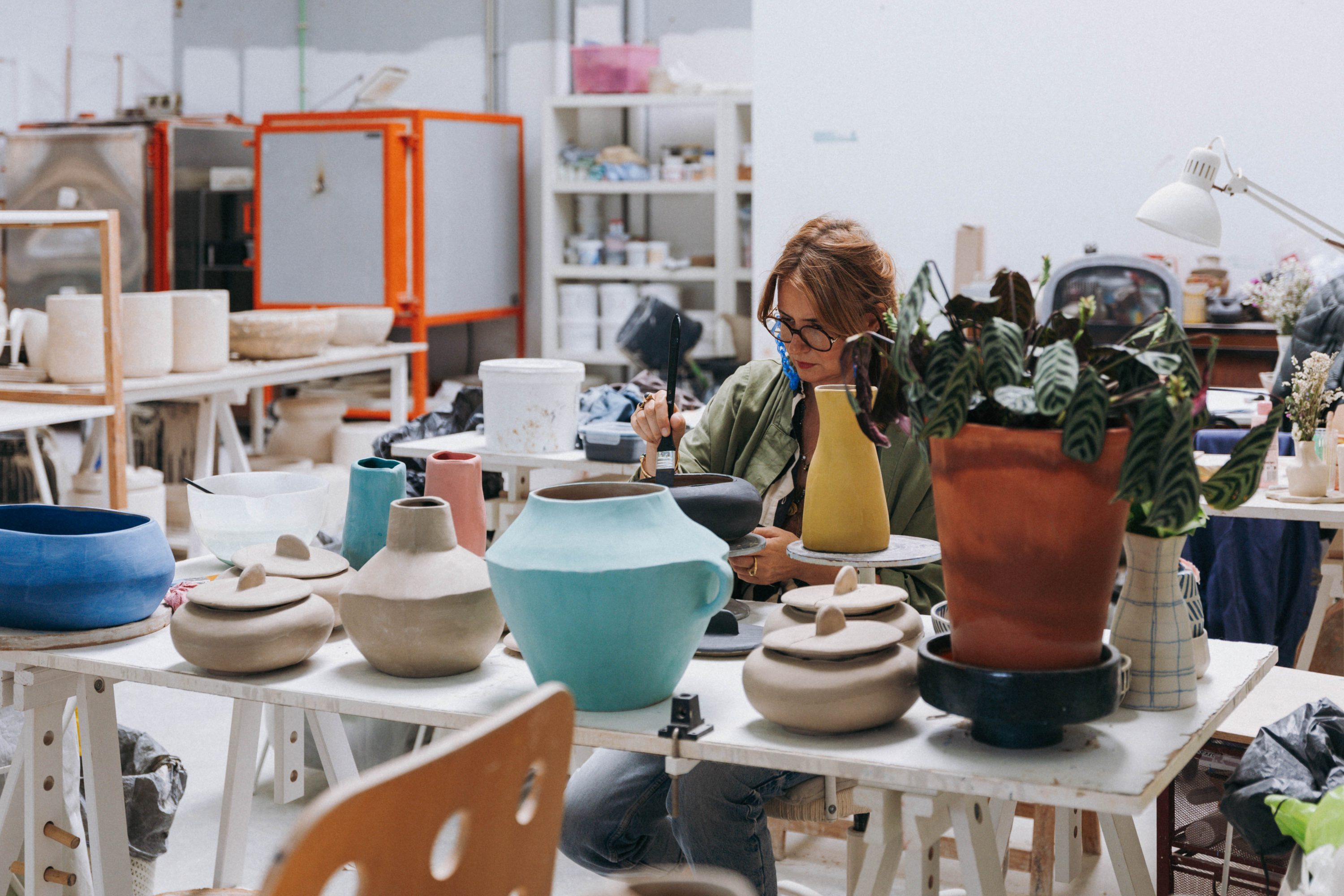
This space has evolved – since I moved in rather quickly and chaotically – and I’ve been organising it to bring structure not just to the studio, but to myself. Only very recently have I carved out a space of my own within the studio, which has become my little bubble. I usually tell people: “When I’m here in my corner, don’t talk to me.” It’s all a work in progress, in the sense that the space seems to evolve alongside the way I relate to my work and the studio itself. Perhaps there’s a reason I’ve only created my little nook now; I felt this need to step back and look at my work from the outside.
Do you have a routine for your day? What is a typical day like here in the studio?
Truthfully, I don’t have many rules for my day, and I think that’s one of my handicaps. My biggest challenge is setting boundaries, allocating specific time slots for everything I need to do. So, I tend to go with the flow, dealing with things as they happen and doing whatever needs to be done. But of course, there are moments when I’m completely focused on my work and trying to create. I suppose that’s my main rule: blocking out chunks of time where I can just focus on making things, prioritizing that time. That, and my children, who interrupt my day several times – but they have full permission to do so (laughs).


This feature by CIN Antologia is all about celebrating the stories behind the creators. If your pieces could talk, what stories would you like them to tell the people who take them home?
I’d like people to feel that they carry a happy energy and a shared vibration with others. And I’d love them to speak of this laid-back approach to life, this freedom of mixing colours and patterns without any grand pretensions – in the sense that they don’t aim to be important, but they do wish to matter. Something like that.
What kind of colour palette do you need around you to feel inspired and balanced?
Colour is my absolute favourite working medium; it is incredibly important. Not just because it carries emotion, but because it communicates with us. So, when I say it’s my favourite medium, it’s almost as if I feel I could work with any material as long as colour is involved. One of the things that gives me the most pleasure is thinking about colour, playing with combinations, and seeing how completely different things look when you pair one shade with another, or tweak the tone just slightly. Sometimes it gives me a sort of childish excitement. So, are there specific colour palettes I identify with more? I like colours with personality – vibrant colours.

How does choosing a colour palette dictate the birth of a piece? Does the colour come before the form, or does it adapt to the texture of the material?
There are times when I picture the colour of the pieces first, but I think my process usually goes a bit like this: I see the piece as a body that gets dressed first in clothes, a pattern, a textile layer, and then gets adorned. In other words, it’s only after it’s dressed that I choose the accessories to complete it. So, while there might be a specific project where I must think about the colour first, it usually comes after the form.
In ceramics, the colour applied before firing changes dramatically after it comes out of the kiln. How do you deal with that ‘surprise’ and transformation? Is it a process of control or surrendering to the unexpected?
Yes, colour in ceramics is a massive challenge. Of course, with practice, you learn to see the final colour beforehand. But I remember my very first project when I was studying ceramics; the pieces went into the kiln supposedly a bright, clean white and came out a yellowish beige. My teacher told me I’d “better get used to it.” And I was like, “No, no, no, no, that’s not how this works.” Colour is genuinely important to me; there’s no compromising in that sense. Because of that, I probably got into the habit of doing a lot of colour tests first. Granted, the element of surprise can be interesting, and it doesn’t mean you won’t like the result, but I like to control the palette I’m working with. In that sense, ceramics requires a lot of forward planning.
Your work often mixes ceramics with textile elements. How do you balance the colours between such different materials? Does colour serve to bridge these two worlds or to create contrast?
I think one of the reasons I brought these materials together is precisely because of colour. It allows me to have a much broader palette. In ceramics, I couldn’t always find such vibrant shades, or manage to work with specific colour combinations, so bringing in other materials expands my options. It gives me greater freedom.
Sometimes, a ceramic piece is made in a specific colour with the intention of pairing it with a certain textile shade later. That next phase really breathes new life into them. To be honest, there are pieces I don’t even particularly love when they come out of the kiln, but when they reach the stage where I add the other materials, they take on a whole new life. I think that comes down to the colour combinations that happen right there.
Is there any colour you dislike working with?
I don’t think there’s any colour I dislike working with.
And do you have any favourites?
I do. Or rather, more than favourite colours, I have favourite colour combinations. Some are a bit cliché, like pink and red, orange and pink, or burgundy and olive green. Mixing colours is just a brilliant, fun game.
What is your most colourful memory?
It’s funny, because the first thing that popped into my head was being a little girl picking and eating blueberries. My dad is Swedish, so I had a very free childhood in the countryside, and what I loved doing in the summer was going blueberry picking – they weren’t like the ones you buy now, because they turned me completely blue, tongue and all. Afterwards, we would sit by the side of the road, and whenever a car drove past, I’d stick my tongue out to show off my blue tongue. I think that’s the very first colourful memory that comes to mind.